
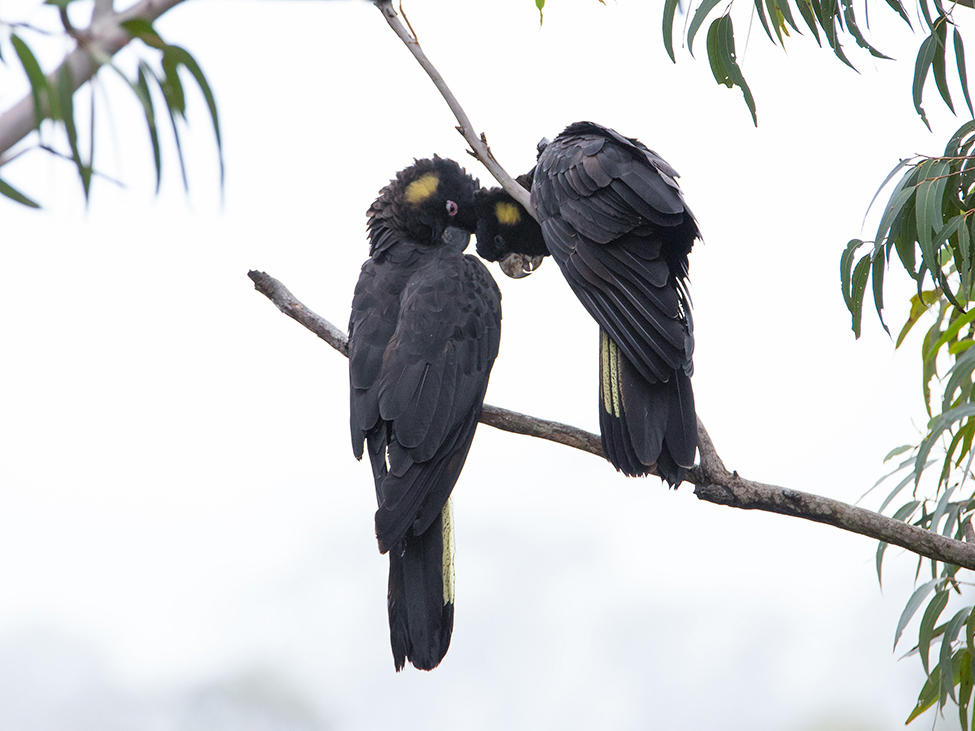
 Round this time of the year, Yellowtail Black Cockatoos come through more often than usual, sometimes in large numbers. They are amazing birds – enormous even by cockatoo standards, full of insistent faraway calls and eccentric behaviors. They settle high in some large pines near our place and demolish the pine cones.
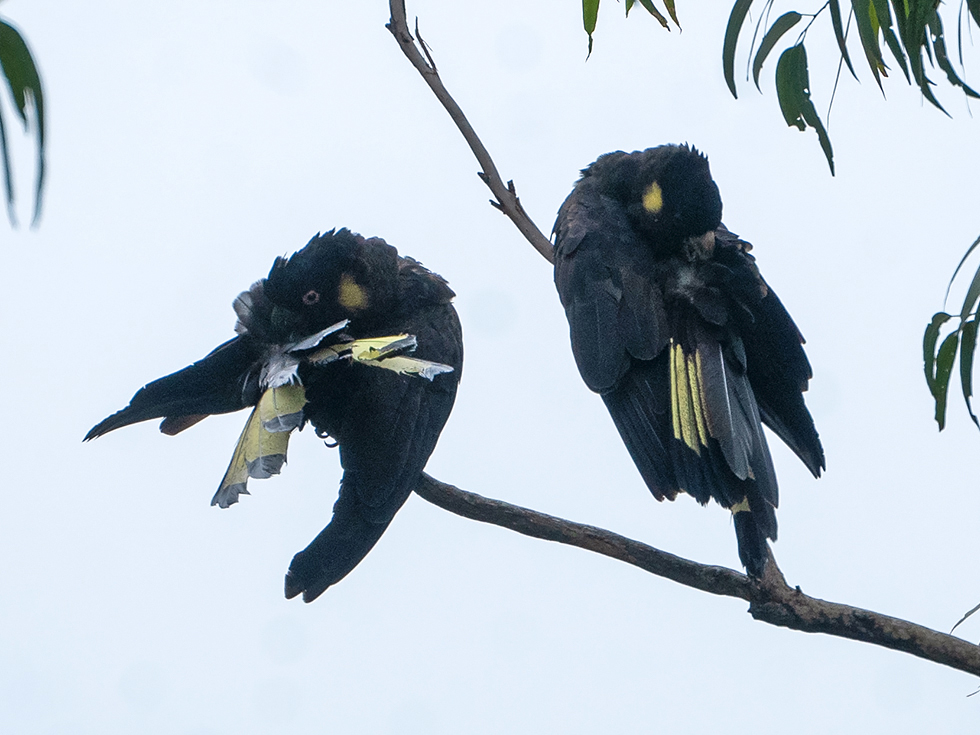
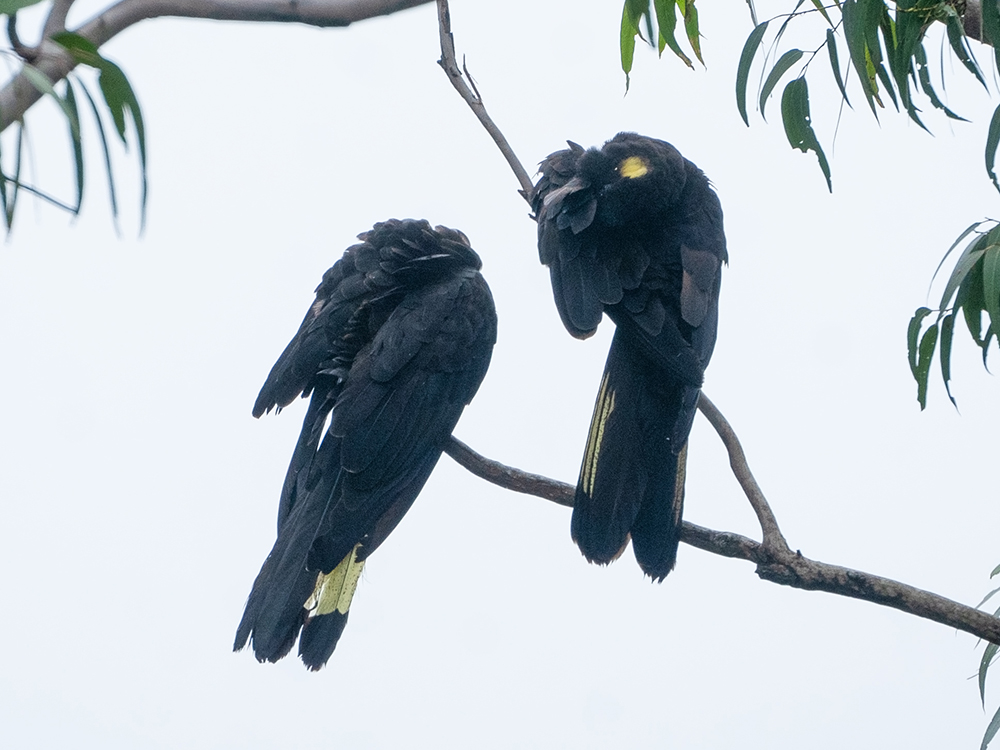
Last week, a trio of them spent some time closer in, sitting on a couple of low branches of another tree. In all these photos, the bird on the left is a juvenile, I think. He or she was fed mouth-to-mouth a few times. There was a lot of grooming.

During the time I was watching, the grooming was mostly done individually. Each bird would mess around with their own feathers. Occasionally one seemed to groom the other, always right to left I think (but not entirely clear). And during the time I watched, it seemed to me that the individual grooming was quite often partially synchronized. Both would be bent over the same way, or both upright. Or both taking a pause. It may be that the juvenile is copying, and learning from, the adult – perhaps a to-and-fro where the adult is grooming itself anyway, but makes sure the juvenile can see what’s happening. Alternatively, perhaps this is something that does not need to be taught or copied at all. It seems pretty simple. Cues from one’s own body might be all one needs. In that case, why the apparent synchronization – partial, and occasional, but still something I found myself noticing?
A sequence of three photos, taken fairly close to each other:

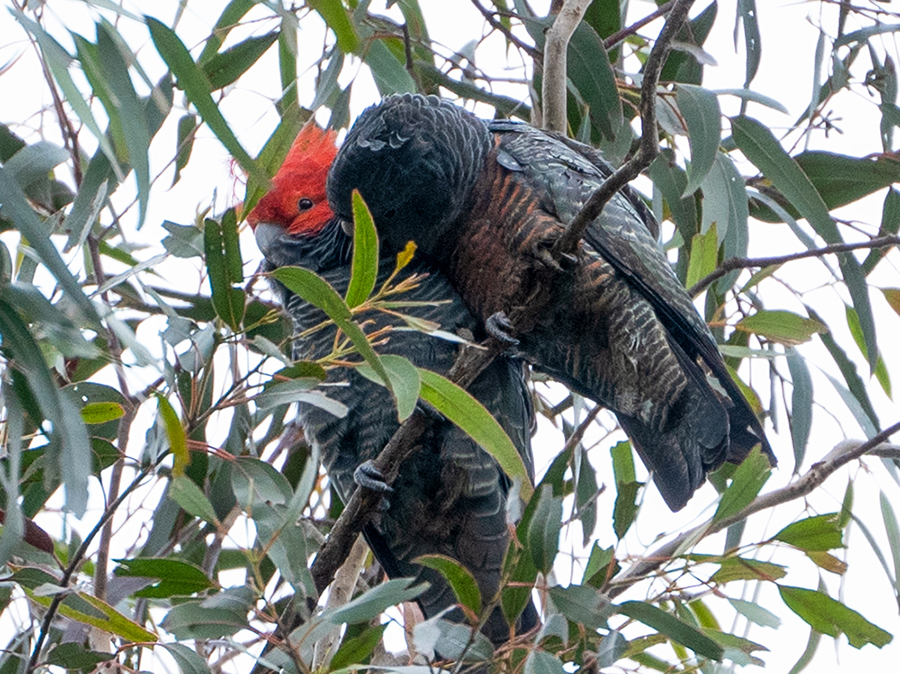
An impression I’ve been getting more and more from various species of cockatoos (Gang-gangs, Glossy Black, Rose-breasted…) is that pairs of these birds seem to like each other a lot – they like being close, like nudging and poking and messing around, more than seems necessary even for a mating pair. I have a planned post from a few months ago with some photos of Gang-gangs who seemed to enjoy each other’s company very much. This was during a colder time, and shared warmth might have been part of it. Here is a photo:
Rose-breasted cockatoos (Galahs) are famous for playing, both socially and on their own. During storms, they sometimes hang upside down from overhead wires with their wings out. Perhaps this is in the service of cleaning, an inverted shower, but it looks like, and is often described as, something they just enjoy.
What about the most numerous, noisy, and human-engaged cockatoo species, the Suphur-crested Cockatoo? I’ve not noticed the same sort of bird-to-bird apparent affection in this case, but I tend to watch them less closely and it may well be there. A facebook post from a few months ago described a situation where a Peregrine Falcon killed one cockatoo, and his or her apparent partner seemed distraught. I have a few screenshots from their video, and they are quite hard to look at.
I should have got some video of the Yellowtails. The quality would have been no good unless I went to get a tripod, and they might have left while I was doing that. But I don’t think that’s what stopped me. Why do I take so little video in such cases? It won’t be pretty, but it can capture the behaviors, their rhythms, in a different way from stills. I need to remember that, and try hard to capture (I hate ‘capture’ – photograph) the rhythms of bird behavior, especially behavior that seems, subtly but powerfully, to show the affection of one for another.

_______________
* These photos were taken with two different cameras and lenses. My old Canon 6D with a big Tamron 150-600, and my bushwalking camera, a Sony α7c with its 70-300 (not top of the Sony line). I am entering a gear transition at the moment, trying out different combinations. In order: Canon, Sony x 4, Canon.
** This is a phone audio recording of an absolute racket made by all the local birds the day after the photos. Lots of lorikeets and kookaburras, also others. (No yellowtails, I think.) A good time of year.