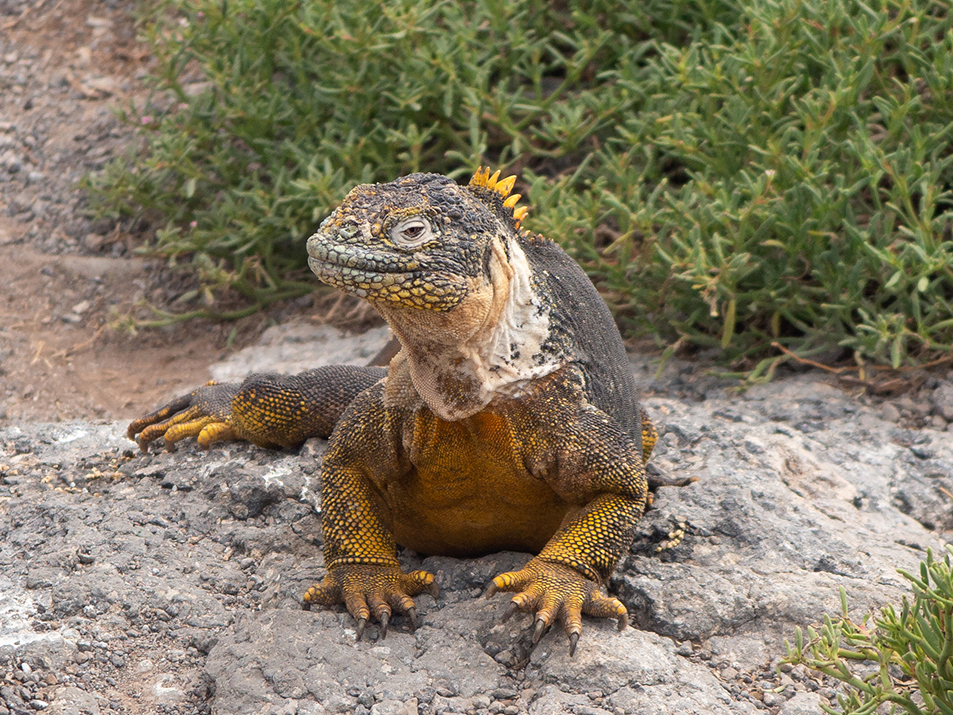
A Galápagos land iguana. I’m back from a floating week-long workshop on the “Distribution of Consciousness,” organized by the International Center for Consciousness Studies (ICCS). Many thanks to Dmitry Volkov and his colleagues at the Center.
This post is a place to upload the text of the talk I gave, “What Difference Might Biology Make?” Here it is, pretty close to the way it was given, with some extra notes and an appendix added about AI.
I tried in the talk to do two things. One was to suggest a potential role in consciousness for the large-scale dynamic processes in the brain that I’ve been discussing on this site in the “Rhythms and Fields” posts (1, 2, 3). The other was to use this example of a “biological” feature to explore in a general way the opposition between views presently labeled as “computational functionalism” and “biological naturalism.” I wanted to shift how people think about the relationship between computational properties and the hardware underlying them. Suppose you were convinced by the empirical arguments about the importance of large-scale oscillations and the like, not just in relation to the general working of the brain, but in relation to consciousness. What would that show, or suggest, about functionalism, biology, multiple realizability, and so on?
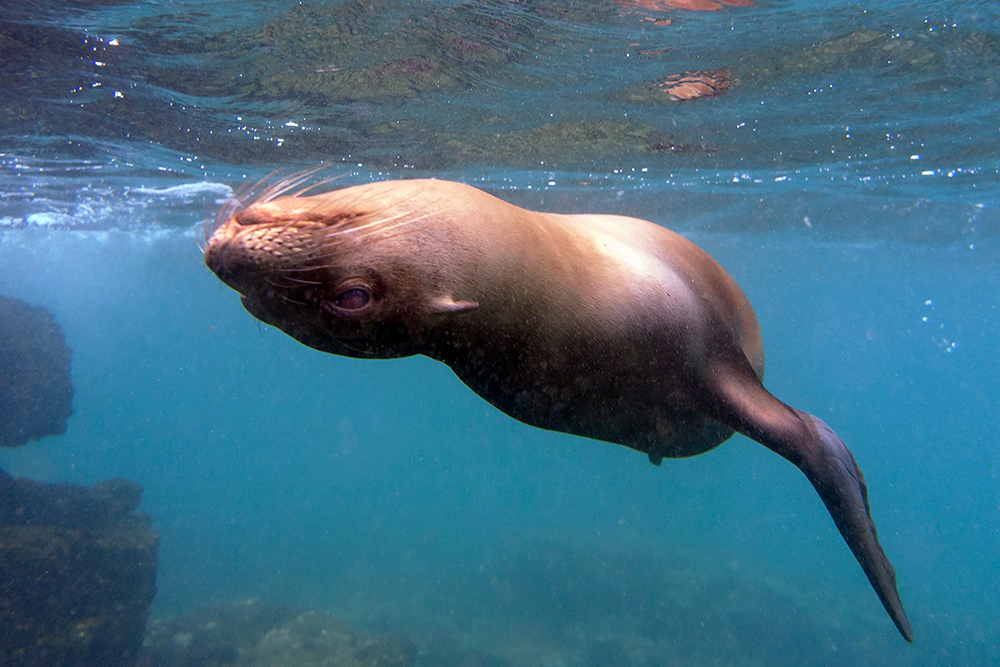
I am not sure I succeeded in the “shifting how people think” task, and there was some resistance also to the “Rhythms and Fields” themes. But it was a great week, both intellectually and natural-historically. I was entirely dazzled and seduced by the Galápagos sea lions. I’ll write about them some time, and I have a stack of photos. One for now:
If you write a comment on the post from this front page, the letters will look very small as you type. Write from here to avoid the problem.