Last April I wrote a post called “Rivalry,” about the use of animals in experiments. It was prompted by a controversy over the work of Nikos Logothetis of the Max Planck Institute for Biological Cybernetics. Logothetis has for decades been a leader in the scientific study of consciousness. He has done elegant and ground-breaking work. In 2014 some shocking undercover video was released of suffering by laboratory monkeys in his institute. The monkeys have electrodes permanently implanted in their brains – a standard method in neuroscientific research. The “Rivalry” I wrote about is the clash between the goal of pursuing scientific knowledge and the goal of avoiding harm to animals whose lives are under our control.
I said at the time that I was uncertain whether these monkeys were used in Logothetis’s own lab, or some other lab in his unit. They seemed likely to be his, though, and in May, Logothetis announced that due to the pressure he is abandoning primate work, and will work only on rodents.
Alva Noë, a philosopher, wrote a piece on his NPR blog after Logothetis’s announcement. Noë says that Logothetis is reported to have been frustrated that the Max Planck Society “has been unwilling to pursue criminal charges against activists who have targeted him and other researchers.” Noë says he admires the courage of the animal rights activists, but “it is shocking to think that institutions of research and learning may not be equally willing to act in support of their own values.” I wonder whether the Max Planck Society did not back Logothetis because they, too, were dismayed by the video – it’s hard to imagine watching it and thinking there’s no problem. Perhaps they decided they did not entirely support what was going on.
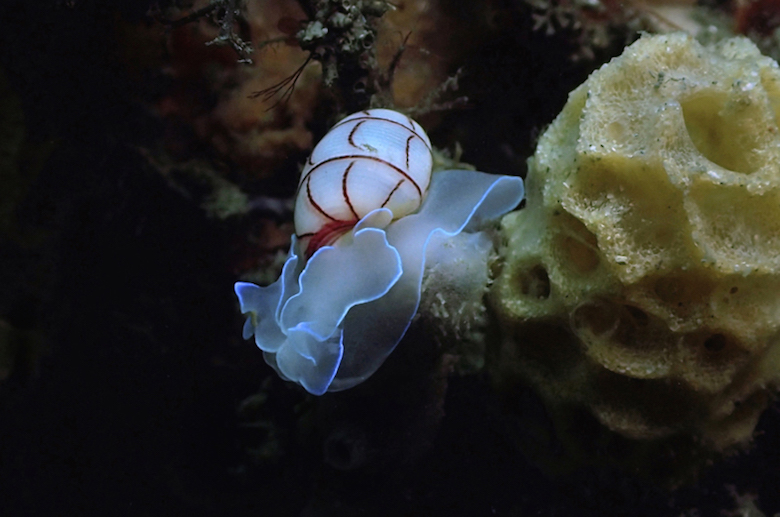
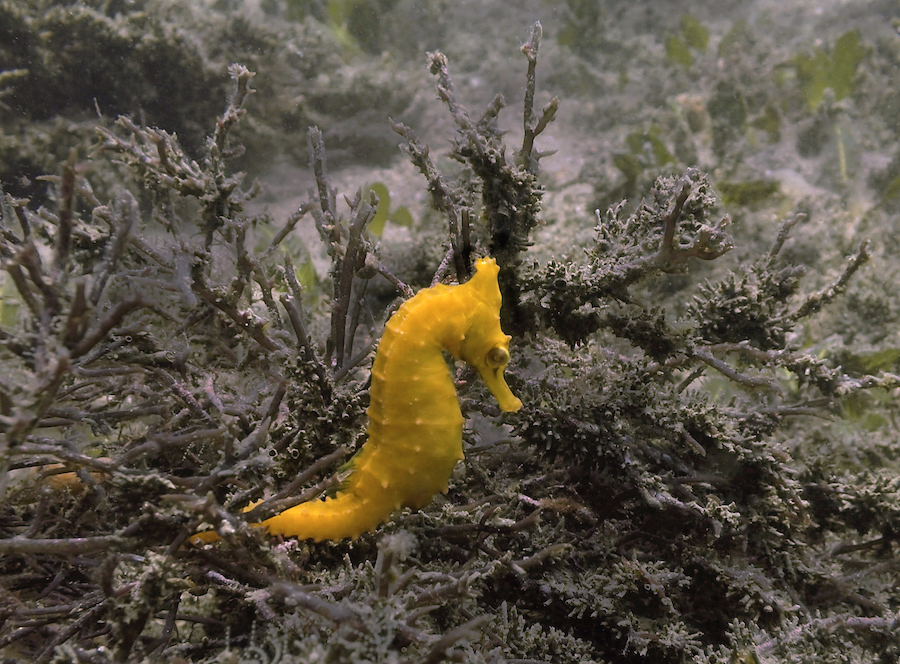
(Most of the photos I take are not relevant to this post, but I’ll break the text with couple of pictures, taken during a trip to Nelson Bay a week or so ago, while I was thinking about these questions. The first animal is a White’s seahorse, Hippocampus whitei. I was surprised also to encounter, during a single dive, several of the semi-luminous gastropods, Bullina lineata, that I wrote about last time – animals I’ve rarely seen. One is just above.)
___________
After the video emerged, Logothetis wrote a defense of the institute’s animal work, posted on the MPI website. He thinks that objections to the work are based in a sentimental view of nature, one that does not face up to the way the world works.
In the words of the Nobel laureate David Hubel, we often tend to take a ‘starry-eyed’ view of nature rather than seeing it the way it really is. Whether we like it or not, cats are carnivores, and so are boa constrictors. If you own either as a pet, you will have to feed them meat if you want them to survive.
In some parts of Logothetis’s defence, it seems he thinks that once we recognize the violent nature of the natural world, it absolves us from anxiety about causing suffering.
Is it true that opposition to animal experiments comes from a naive view of nature? In 2014, another philosopher, Philip Kitcher, gave a talk about this at a conference we both spoke at, and his paper just appeared in print, here. Kitcher’s paper is an attempt to understand animal experimentation within a Darwinian view of nature, one that avoids what he calls “peaceable kingdom thinking.” Violence and death are central to the biological world – “suffering is not incidental to life but written into the script.” Further, whatever humans decide to do in our dealings with animals, our actions will modify the operation of natural selection, and will make some beings better off and others worse off. Given our embedding and our unusual capacities, there is no opting out.
Kitcher’s paper then tries to work out what sort of relationship we might establish to non-human animals, especially those used in experiments. He does this with an unusual philosophical move. I’ve come to think the move itself is probably a mistake, even though it takes Kitcher to some good ideas.
The framework Kitcher applies is “contractualism” – an approach to moral questions based on the idea of negotiation and agreement.* We can’t always actually negotiate and strike deals with the parties affected by our decisions, so sometimes we choose – or imagine – proxies who might speak for them. Kitcher suggests we approach questions about animals in this way.
The very young, the severely developmentally disrupted, many of the old, and all the members of future generations cannot present their points of view on matters that affect them. With respect to such issues, contractualism—when it is practiced—must include representatives of their perspectives. The same can be done for nonhuman animals.
They cannot present their wishes to us, but they can be represented by proxies – not just in imagination, but by people on the committees that control the use of animals in research.
Kitcher notes that most animal experiments today are done on fruit flies, worms, and other organisms for whom the moral questions don’t seem very pressing. Mice are a different matter, as a huge amount of research is done on them, much of which is harmful. A rarer and more problematic case is work on monkeys, such as Logothetis’s work.
Kitcher makes suggestions about what the committees that assess these questions should look like, and what they might decide to do. Some of his suggestions are not surprising: there should be a lot of control of pain. But such a committee might also decide that when animals are to be used in experiments, the individual animals have, before the experiment, a period of time as long as, or longer than, their usual wild lifespan, in which it experiences what Kitcher calls a “lab-normal” life, one where it is healthy and behaviorally fulfilled. Experiments that cause significant harm only come after that.
In the case of mice, this would not be hard to do, partly because their wild lifespan is so short. In that case the committee might require: “a year… in which the mice enjoy a controlled environment in which they can satisfy all the drives recognized by experts on their physiology and behavior.” For monkeys, which are much longer-lived, it would be more difficult to bring this about, but not impossible.
Kitcher’s final proposal, one not tied to the committees, but to the general idea of a contract-like relationship with animals, is that it should be possible for humans to offer themselves, at very end of life, for experiments that can also benefit both sides – humans and non-humans.
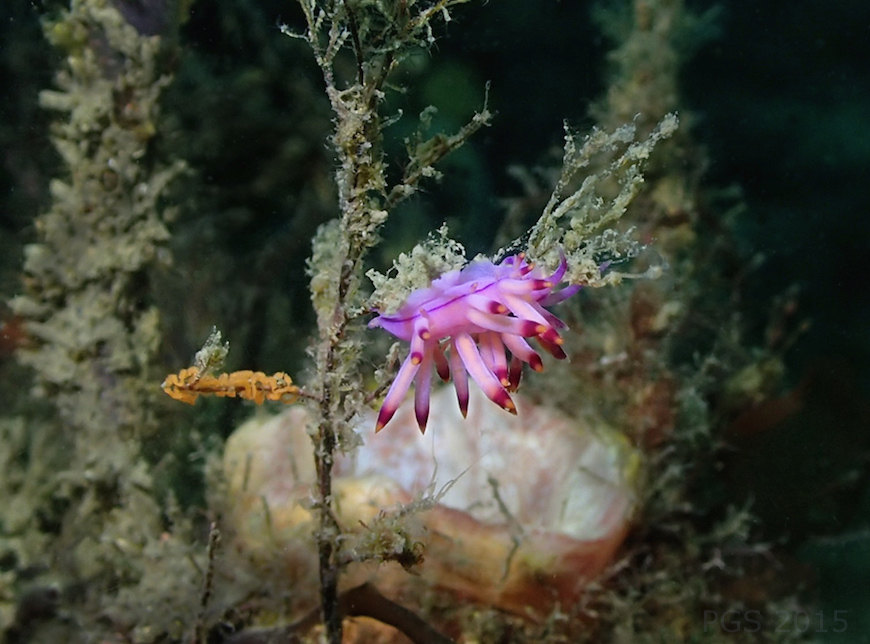
(Here is one more animal from the trip to Nelson Bay. This is Flabellina, a nudibranch. The orange scroll to the left, on the branch of seaweed, is a cluster of nudibranch eggs, quite likely those of the Flabellina. The animal is less than a centimeter long. It is upside down and its head is to the right.)
In my earlier discussion of the Logothetis work I made two initial suggestions:
1. We should phase out invasive research on primates that is driven by scientific curiosity, rather than definite medical goals.
2. We should ensure that animals used in experiments have a life worth living.
In trying to make sense of “a life worth living,” one thing I said is that they should have a life as good as, or better than, their wild cousins. These are quite different approaches, though, which I didn’t properly distinguish. There’s a life worth living, and there’s a life better than the wild analogue. There are interesting relations between these. What is the appropriate test in cases where the wild state is not very good, or cases where we can give an animal what seems a decent life but one not similar at all to the wild one? I am not sure, but both approaches seem generally reasonable.
Kitcher doesn’t make a distinction between work aimed at medical outcomes and “basic” research driven by scientific curiosity (as in my clause 1). He is skeptical about the distinction as I drew it. The committees he envisages would try to factor in the probability of medical benefits, in any case.
Alva Noë said of the cessation of Logothetis’s primate work: “this is not progress.” I think that it is indeed progress, even though (as I described earlier) some animal activists did indefensible things in the aftermath of the video’s release. Logothetis achieved some remarkable science with his monkeys, but it’s probably time to phase out work of that kind. If such work is to be continued, a new approach to assessing these projects is needed, and we can see how the outlines of those assessments might go. Something extra is gained, also, by Kitcher’s proposal about human volunteering. The “rivalry” that motivated these posts may be on its way to a sort of resolution.
__________
An Entirely Philosophical Note:
Kitcher sets up his proposals as application of “contractualism” (AKA “contractarianism”). This is an approach to moral questions that is often considered unhelpful to attempts to improve the situation of animals, so it’s interesting that Kitcher presses it into service here. But I think it’s probably not the right move.
(Kitcher is not the first person to apply contract-based moral thinking to animals. Mark Rowlands has a 1997 paper on it here. Martha Nussbaum looks at the idea here. Bernard Rollin has also worked on it.)
From a functional point of view, contract-making is a solution to a certain kind of problem, a tool for specific situations. The existence of a contract or agreement gives rise to a particular kind of justification, and a particular kind of ease about what one is doing – “I know it looks weird but he agreed to this. It’s part of the deal.”
One tradition in moral philosophy tries to extend the idea of a contract – by positing hypothetical negotiations – and treat it as the basis for a general theory of moral or political affairs. This reflects a tendency in moral philosophy to try to find a fundamental principle. Kitcher does not do that, but he offers contractualism as the closest thing we have to a general methodology for thinking about moral questions. We then have to work out, in each case, the extent of the analogy between a real contract and the imaginary extension. In the case of animals, talk of a contract is appealing because it suggests a fresh start. But contracts are two-sided. They are out of place in situations that are inevitably more paternalistic, where there cannot really be agreements between the parties, and the case of experimental animals is certainly of that kind. In the early days of domestication, there perhaps was sometimes a sort of mutual coming-together in a few cases, such as dogs. But this is not a general model of the relationship.
I agree with Kitcher about the need to rethink the human/animal relationship. And when we think of the transition to factory farming, there is surely something in the idea that there has been a betrayal on our side. But contractual thinking does not seem to apply well here, and its appeal may derive from giving us a misleading feeling about the kind of justification that can be in place. We need another way of thinking about the problem, perhaps a way based on the notion of reciprocation without this going via the idea of a contract.
________________________
Other Notes:
For a general introduction to the debates about ethics and animals, the place to go is probably here.
Logothetis quoted David Hubel in his defense of animal experiments. If you are a cat lover, Hubel is not exactly a role model, though this work, too, was scientifically valuable.
I invited Logothetis to send a reply to the previous post, but he did not take this up.
I mentioned farming above. A welcome change in the leadership of Australia’s governing party has not, so far, led to any change in policies about the live export of farm animals on suffocating ships to countries where they are killed with great cruelty. If you are going to be reincarnated as a captive animal, pray first not to be a bear in China. And pray also not to be owned by an Australian farmer who thinks live export to the middle east is OK.
The photos all had added light, but the seahorse color is accurate.
It seems bizarre to me to think we can justify experiments taking place after a ‘lab-normal’ life if we might not justify them otherwise. The best I can do to wrap my head around this is to think it’s based on a strange utilitarian calculation. Presumably, he thinks that if these animals attain a (super-)ordinary life-span through harmless human intervention, then at some point they lose their full moral status because they are either no longer entitled to it or because a sufficient store of goodness has been built up pre-experiment for us to spend a little on vice in old age. But even within utilitarianism, this is shown to be unacceptable if we transfer it to humans: would we argue that a human who reaches the age of 90 can be treated with more blurred ethical lines than a person of 30? At least to my conscience, that is not how ethics should work. The merit of an action must be determined through its present and future consequences; the past does not lend us excuses.
When you put it like that, it does looks weird, I agree.
The reasoning, filled out, might go like this. Consider the case of mice. We could decide not to use them in science, and not to interfere with them in any way at all. Then each mouse has its short life, a mix of things going well and things going badly, and the bad things are not our doing…. Well, those events are partly our doing, as they are living in a world that we’ve transformed, and we’re deciding to take certain actions rather than others now, and those choices do affect the mice. I understand Kitcher’s critique of ‘peacable kingdom thinking,’ which I agree with, as aimed at shifting us away from two ideas: (i) life for wild animals who we don’t interfere with is generally pleasant, and (ii) our actions are outside the natural ecology of animals like mice.
We could, alternatively, use some mice in scientific work, because we think the work is valuable and will lead to various benefits. (I’ll set aside work that is driven purely by scientific curiosity.) Benefits for who? Ideally, not just humans, but various animals as well. (Kitcher uses the case of insulin to make this point.) The work may do great violence to the individual mice in the experiments. The better-than-normal life before the experiment compensates for that.
We could also give some mice a better-than-normal life without doing experiments on them. That costs money, takes resources – it won’t happen, except to a few pets, and there’s no reason why it should. So we choose between two packages, a package where mice, living in a human-transformed world, live short ‘wild’ lives, and a package where some of them live longer lives, with an unusual mix of good and bad.
In arguments about farming, people sometimes imagine farm animals having a happy life without being used for food or other purposes, as the alternative. That’s true of at most one generation of the animals. After that, there would be no farm animals of the familiar kinds at all. The farming case has similarities to and differences from the case of experiments. In farming, one of the choices we’re making is whether there is to be such a thing as a domestic cow, a domestic sheep, with the special sort of life they lead. When we ask whether there should continue to be such things, a first question to ask is whether their lives are worth living. In the case of factory farmed animals today, the answer is probably no. In the case of the best organic farms, it’s probably yes. At the moment when the animal is to be killed, the arrangement can suddenly seem all wrong. (Those are analogous to the moments focused on in your comment.) But I think assessment has to be of the whole package. (Mice can live without our assistance, so I accept that the case is not entirely similar.)
Above I speak for myself, and don’t know how much of it Kitcher would agree with. I’ve also not tried to address the case of primates here, but in the post itself I am skeptical about a great deal of that work.