The word “metazoan,” if unpacked semi-literally, would mean something like beyond animals, or after animals. The Greek prefix “meta” has evolved in scientific and philosophical English now to mean something more like above, or higher-level. (A metalanguage is a language for talking about another language.) Metazoans are multicellular animals. I am not sure if “meta” there originally meant higher, or is a reference to the idea of multicellularity, the idea of an organism made of organisms – living cells.
To be multicellular, a meta-organism, requires a patterning of parts and coordination between them. The cells in our bodies self-organize, differentiate, and produce a form quite different in shape from themselves. This requires some sort of interaction, “signaling” in a broad sense of that term, or another process whereby each unit affects the micro-environment encountered by other units, perhaps just by shielding or filtering external stimuli.
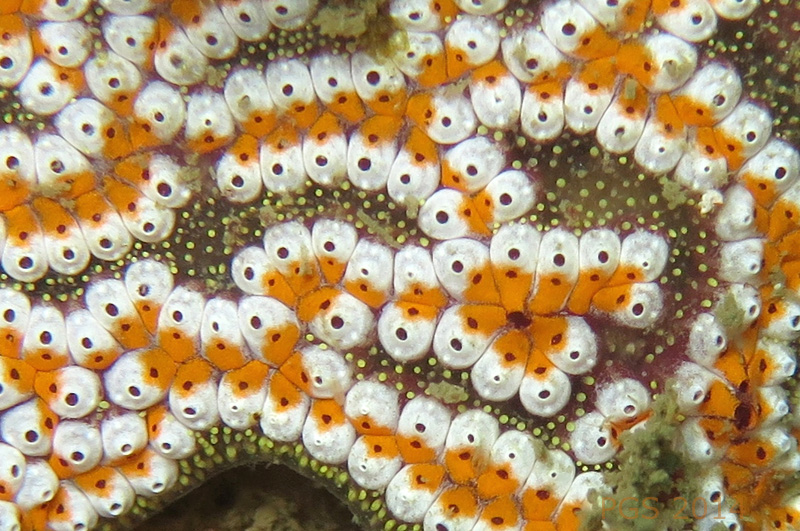
There are also organisms that would more truly deserve the name metazoan, as they are made not only of cells, but of organism-like units that are themselves multicellular animals. These units are often called zooids. Zooids are partly autonomous, with a life of their own, and partly integrated with others of their kind. The photo at the top is a colonial ascidian, Botylloides leachii, seen at Chowder Bay in Sydney Harbor last year. (The photo is zoomed in – here’s a shot from further back.) Each zooid is a miniaturized sea squirt, with holes through which water is passed for feeding.
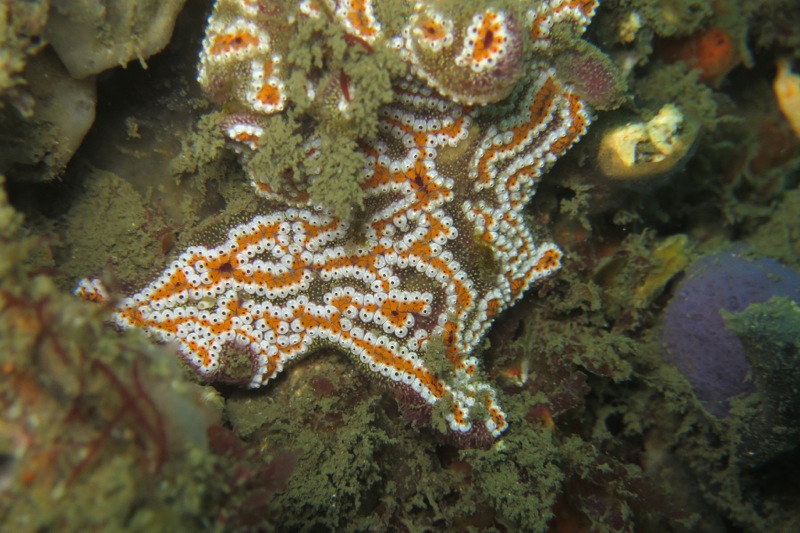
Given this, it was interesting to see the form taken by another colony at the same site:
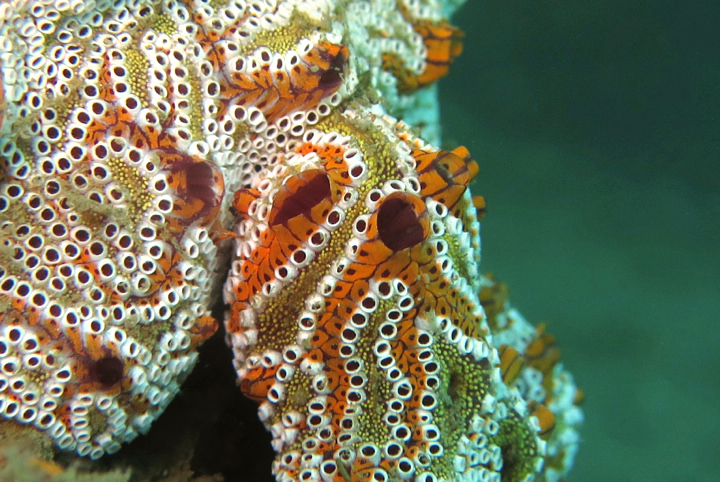
Rather than a loosely organized carpet, the colony forms a shape in which many zooids together create an outflow spout (a siphon). If you look closely at one of the siphons you see that something like five to eight zooids have combined their bodies to form it. (The beginnings of some of these can also be seen if you go back to the colony at the top.)
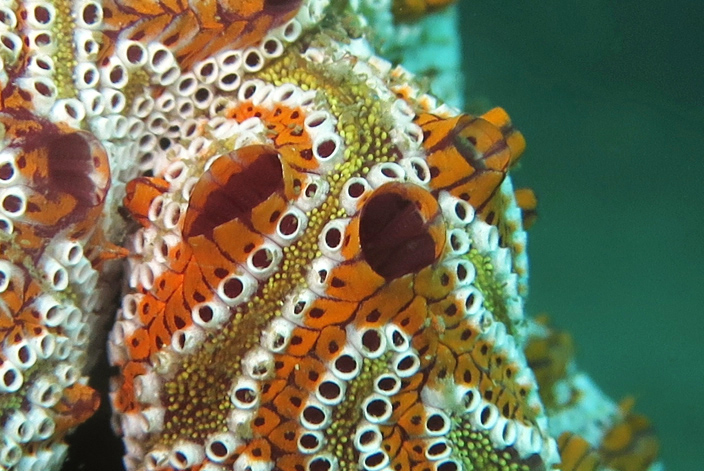
So this is a meta-ascidian, and a metazoan in that richer sense. Within each ascidian zooid, there are spout-like siphons. Each dark patch within a white area is the incoming siphon for a single zooid. This, again, is a little multicellular animal of its own. One zooid buds off from another, and the colony is made up of genetic clones. But the colonies organize themselves to produce a collective spout, a meta-spout, as well.
I’ve spent some time puzzling over some features of these photos, with help from ascidian expert Mary Beth Saffo. For example, if the huge collective multi-zooid spouts are outflows, and the white spouts are inflows, what are the apparent holes in the center of the orange patch on each zooid? Are there individual outflows as well as the collective ones? I assumed these are indeed holes, but Saffo suspects they are patches of pigment, patches of darker color, so the zooids have individual intakes and collective outflows only, where the orange “posterior” end of each zooid (the end far from the intake) collaborates in the formation of the outflow, and the zooid has an unseen way of passing water from its individual body to the collective outflow. (I am sure “posterior” is nothing like the right word to use here.)
The only way to work this out for sure is to get back to the site and take some flash photos very close, and also, as Saffo suggests, to suspend some colored liquid near the colony to watch its movement in and out. I’ll do this as soon as I can get back there.
Like Saffo, I marvel at the ability of zooids to organize themselves into these shapes, a scaled-up and simpler version of the invisible organization of cells into our animal bodies. I like also this facet of scale-invariance in the ascidian form, where collectives recapitulate a central feature of the shape of each zooid. It is as if an ant colony formed a giant ant, or a collection of humans came together, each human a patterned collection of cells, and with no overseeing control they formed a pattern from which emerged the shape of a single huge person.
________________
Notes
I assume the green dots in each of the photos above are bits of algae, living among the ascidians. [* No – see the comments below for a correction].
Saffo’s work on these animals includes the discovery of a very unusual symbiosis. A larger ascidian contains a symbiotic apicomplexan. This is the group of single-celled organisms that includes the malaria parasite, and many other thoroughly and resolutely parasitic creatures. Only ascidians seem to have tamed them.
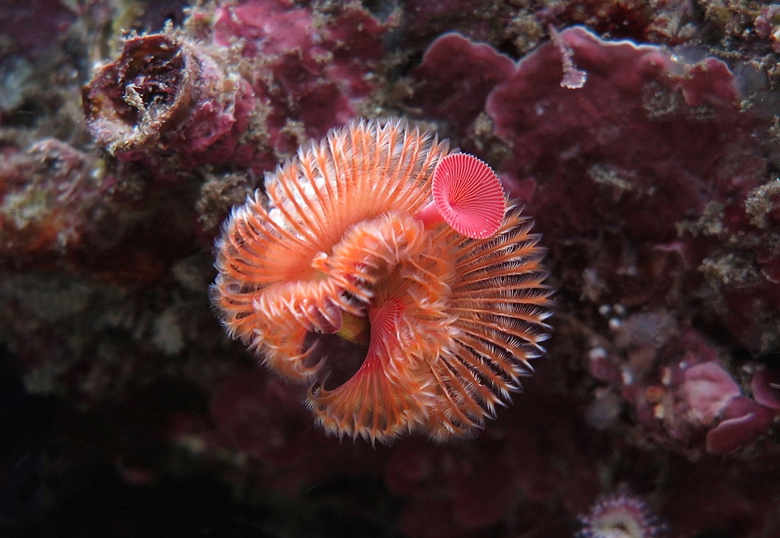
Ascidians are surprisingly close to us on the evolutionary tree – closer than other invertebrates. Their location is discussed here. Speaking of colorful invertebrates, last week I came across a slightly less irritable, slightly more patient serpulid worm, of the kind discussed in the previous post.
When you go back to experiment, look again at the green dots too. I would think if it was algae you would see it growing along the white siphons but it appears to be neatly contained/cultivated.
Mary Beth says I am wrong about the green dots. They are not algae at all, but part of the ascidian(s). “They are terminal ampullae of the blood system, involved, among other functions, in non-self recognition; some of them can give rise to new zooids.”
Absolutely fascinating – & very beautiful…
Very cool discussion, and good pictures. McShea makes a nice distinction between order and complexity, and I wonder what you’d have to say about how those features are being exemplified in these organisms and others like them. Order involves similar parts that are patterned in an easily specifiable way. By contrast, complexity involves lots of different kinds of parts, irregularly arranged. It seems like these colonies might be very ordered, and exhibit a kind of meta-order, insofar as their colony-level form basically recapitulates the form of their parts. Compare this to some other zooid cases, like the Portuguese man o’ war, in which the zooid forms are more variable and aggregate into something that is unlike the parts. Perhaps that is a mark of more complexity?
Here is a first thought in reply, though I might come back to this. I agree that in McShea’s sense (which is a good sense) a Portuguese Man o’ War has more complexity than an ascidian colony of this kind, because there is (I take it) more differentiation of parts, and a more complicated division of labor. That judgment is made by looking at the relations between one part and another part at the same level in the hierarchy (one zooid compared to another zooid): there’s more differentiation in the PMOW case than in the ascidian case. I don’t know how to factor in the ‘recapitulative’ feature of the ascidians, the fact that zooids look a bit like their colonies. That’s a cross-level (zooid to colony) comparison of similarity. It could, as you say, be seen as a sort of meta-order, though I’m not sure what to make of that property.
Thanks, Peter, for the email alerting me to this discussion. (Great pictures and descriptions of those ascidians, btw.) I have an uncompromising and even humorless understanding of complexity — my attempt to make the notion operational and useful for science. There’s horizontal and vertical complexity. Horizontal complexity is differentiation within a level of organization, consistent with the way that Austin and Peter first use the term. So for an ascidian colony, horizontal complexity might be the number of zooid types. At a lower level, the horizontal complexity of a single zooid is the number of part types (perhaps tissue types) within that zooid. And the two measures are independent of each other. The horizontal complexity of a zooid could be high (many tissue types) while the horizontal complexity of the colony is low (few zooid types). Or zooids could be simple while colonies are complex, etc.
Now this is horizontal complexity of *objects*, number of part types. There’s also horizontal complexity of *pattern,* the arrangement of the objects in space. As Austin and Peter note, regular patterns are simple, and irregular are complex. And importantly, complexity of pattern and complexity of objects are independent in principle. A small number of different object types can be arranged regularly or irregularly. A large number of different object types can be arranged regularly or irregularly.
Finally, there’s vertical complexity, which is just the number of levels of organization. If we take a tissue to be the bottom of the hierarchy, then a zooid is one level up from that (because it’s an association of cells) and the colony is two levels up (being an association of associations). Like the different levels of horiz complexity, horizontal and vertical complexity are independent of each other. Number of levels is independent of the number of part types — and also independent of irregularity of patter — at each level.
So, finally coming around to the question that Austin and Peter raise, what can we say complexity wise about the repetition of pattern from one level to the next? Not much. We can say that the complexity of pattern at level 1 (let’s call it), the level of the zooid, is similar to the complexity of the pattern at level 2, the level of the colony. But in my scheme it doesn’t add any greater complexity to the whole. We can’t add those complexities, because they’re at different levels. Apples and oranges. Don’t get me wrong. I think it’s really *interesting* that those patterns might be similar, biologically interesting. Could be there’s some similar process at work governing pattern at the two levels, and there could even be some single process — some morphogenetic gradient? — that propagates up across levels. That would be very cool! … I’m just saying that in my humorless uncompromising world of complexity, there’s nothing that registers on the meter, so to speak.
Thanks for including me. Happy to say more, if wanted …
Dan
Thanks, Dan. This makes sense. “Humorless and uncompromising,” perhaps, but definitely a useful framework.